An interior geography | Curatorial Essay
The following is the curatorial essay written by Camilla Pigato about the series The Maps of Time and Rome.
Behind the visible form of a city lie infinite possibilities of meaning. Beneath a geographical map, which fits together streets, squares and buildings, a silent web of memories, emotions and bonds with places is woven. It is an emotional rather than topographical dimension, one that takes shape within each of us while those spaces continue to exist in their physical form. It is within this ambiguous relationship that Maps of Time and Rome takes shape: Claudia Palmira’s artistic exploration of Rome through memory, transforming cartography into an instrument of poetic exploration.
Claudia Palmira moved to Rome in 2006. “When I came to Rome, I didn’t know the city; everything was new,” the New York artist explains. Her abstract, nonlinear way of thinking thus encountered the symmetrical chaos of Rome, a city of complex equilibrium. Through the people she met and the experiences she lived, however, the city gradually took on increasingly personal characteristics, and every street, monument and piazza became imbued with new meaning.
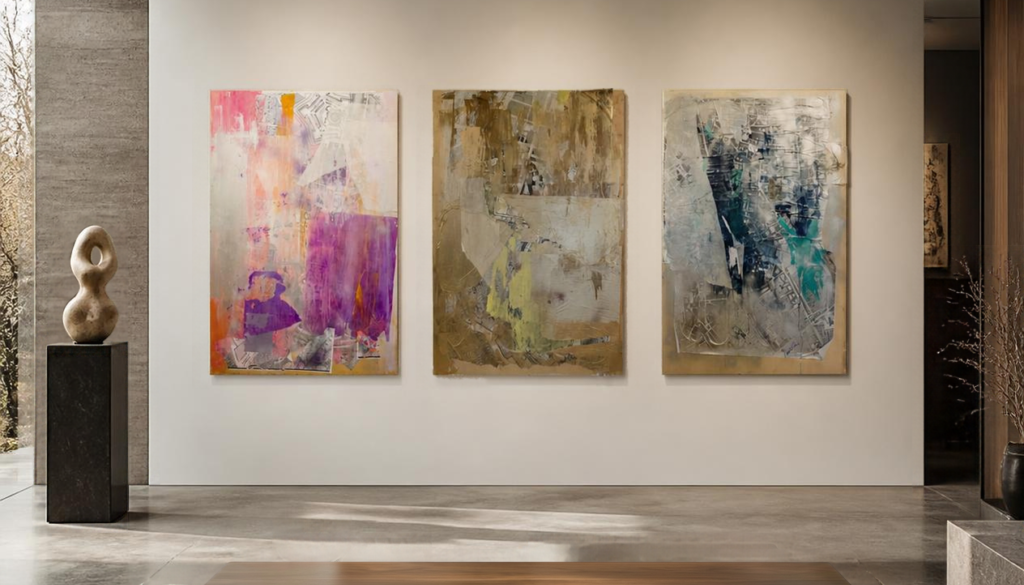
The Maps of Time and Rome series, dating from 2018, is an expression of this way of reading the city. Rome is presented through the historic map created by cartographer Giambattista Nolli (Como, 1701–Rome, 1756), with which the artist says she felt “a connection,” given their shared intention of deciphering an urban space. Nolli sought to create an ordered and legible image of eighteenth-century Rome, documenting its complex spatial structure with precision. Claudia Palmira reinterprets this rational and meticulous organization by superimposing upon it an emotional and subjective perception, which, in the artist’s vision, takes precedence. The city is transformed before the artist’s eyes, becoming an interweaving of personal perspectives and emotions.
The composite nature of the series, created using paper, acrylic and other materials on wood, is significant. In this process, collage takes on a meaning that goes beyond artistic technique. The composition becomes a meeting place between traces of the past and the future, between the memory preserved in cartography and the memory that takes shape through the artist’s gaze. It is a layering of time: the Rome of Nolli’s 1748 map enters into dialogue with the artist’s vision of 2018, bringing two historical moments into relationship with one another. What emerges is an encounter whose common ground is memory, which is never a fixed reconstruction of the past, but a continuous process of reinterpretation.
Each work expresses the artist’s personal relationship with the city. In Centro Pink, warm, delicate shades of pink, orange and violet color the Borgo district, evoking the feeling of being in love in Rome, “like being on a pink cloud,” as the artist describes it. Baciami also reflects feelings of affection, while evoking the convivial dimension of Italian culture, in which a kiss on the cheek is an everyday expression of familiarity. In Roman Night, the light of night envelops Rome in shades of blue, gray and azure, while the golden radiance of daytime emerges in Centro Gold, a work expressing a golden idealization of the city. This vision, however, is deconstructed in Circular Circuito, which conveys the confusion and disorientation of a metropolis that appears to have no boundaries—a sensation that becomes more intense in Broken Whole, a work that speaks of longing for one’s original home.
The series reflects the influence of American artist Robert Rauschenberg (Port Arthur, 1925–Captiva, 2008), whose collages convey the fragmented nature of contemporary reality. Alongside this is the work of Cy Twombly (Lexington, 1928–Rome, 2011), with his gestural mark-making suspended between Abstract Expressionism and calligraphic writing, in which the mark becomes a trace of memory and experience.
A city known as eternal allows us to enter a boundless dimension through which we can read the world not for what it is, but for what it makes us feel. Perhaps it is here that the deepest meaning of these works can be found: in the possibility of recognizing that every place possesses an inner map. Buildings can be described, streets can be traced, cities represented; but the bond that connects us to places belongs to a more intimate geography, one that resides within our emotional life.
— Camilla Pigato
2026